Teradyne sits at a rare crossroads: its semiconductor test business powers the AI infrastructure buildout, while its robotics arm is training the next generation of AI-enabled factory workers. That two-sided exposure is precisely why Teradyne belongs in the ROBO ETF.
 Most companies get to ride one wave of a technology revolution. Teradyne (NASDAQ: TER) is riding two at once. Founded in 1960, Teradyne has spent more than six decades building the automated test equipment that sits between a chip's fabrication and its journey into the world. Today that quiet but essential role has vaulted Teradyne to the center of the AI economy, and its robotics division is making the company's position even more compelling.
What Teradyne Does
Teradyne designs, manufactures, and sells automated test systems and robotics across three business segments: Semiconductor Test (SemiTest), Product Test, and Robotics. SemiTest is the crown jewel, producing the ATE (automated test equipment) that verifies every chip shipped into smartphones, data centers, vehicles, and AI accelerators works as designed. Without Teradyne's machines, a flawed chip makes it into your server rack, and the consequences cascade. In an era when AI chips are among the most complex silicon ever manufactured, that verification step is not optional.
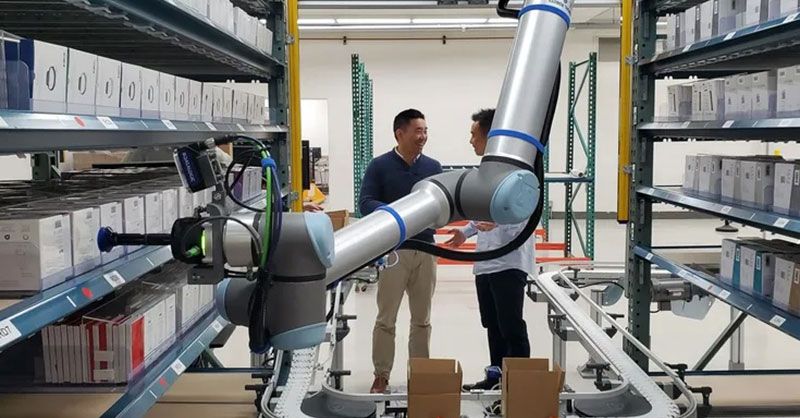
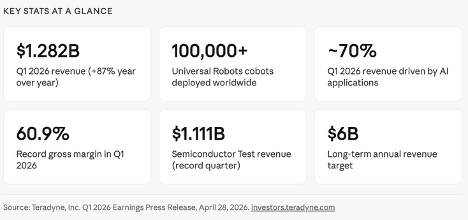
On the robotics side, Teradyne owns Universal Robots (UR), the world's leading maker of collaborative robots (cobots) that work alongside humans in factories, warehouses, and laboratories. Universal Robots has placed over 100,000 cobots across global industrial deployments,1 anchoring what it calls the world's largest cobot ecosystem. Alongside UR, Teradyne operates MiR (Mobile Industrial Robots), which builds autonomous mobile robots for logistics and warehouse operations.
The Numbers That Demand Attention
Teradyne's fourth-quarter 2025 results were a statement. Revenue hit $1.083 billion, a 44% increase over Q4 2024 and the company's second-highest quarterly revenue ever - a mere $3 million short of the peak set during the 2021 mobile boom.2 The SemiTest segment drove the surge, contributing $883 million of that total.2 Within SemiTest, SoC* revenue climbed 47% sequentially to $647 million, and memory test revenue, driven by High Bandwidth Memory and DRAM final test, hit a record $206 million, up 61% from the prior quarter.3
But Q4 2025 would not hold the record for long. In Q1 2026, Teradyne shattered its own high watermark, with revenue coming in approximately $200 million, or 18%, above the previous record set during the consumer-driven mobile peak of Q2 2021.6 Total Q1 2026 revenue reached $1.282 billion, up 87% year-over-year, with Semiconductor Test alone contributing $1.111 billion.6
*A System-on-a-Chip (SoC) integrates an entire computer system - processor, memory interfaces, graphics, and connectivity - onto a single piece of silicon. They are among the most complex and valuable semiconductors ever manufactured, and every one of them must be tested before it ships. That makes SoC test revenue a direct proxy for Teradyne's depth of embedment in the AI chip supply chain.
The metric that perhaps best captures the structural shift: in 2023, compute represented just 10% of Teradyne's SoC product revenue, while mobile dominated.4 By 2025, compute had surged to nearly 50% of SoC revenue - growing 90% year over year - while mobile and auto/industrial each settled at roughly 25%.4 The company that once lived and died by the smartphone upgrade cycle is now decisively tethered to AI data center build-out.
AI-related demand accounted for nearly 70% of revenue, up from roughly 60% in Q4 2025.5.6 Teradyne also maintains approximately 50% market share in the XPU* testing market, the segment serving the custom AI accelerators powering today's largest data centers.7
Physical AI: Universal Robots Learn to Learn
Teradyne's robotics story used to be straightforward: sell cobots to manufacturers who want to automate repetitive assembly tasks without fencing off humans.
In March 2026, Universal Robots unveiled the UR AI Trainer at NVIDIA's GTC 2026 conference in San Jose, developed in collaboration with Scale AI.8 The system addresses a fundamental bottleneck in physical AI development: training data collected on research-grade robots rarely transfers cleanly to the industrial robots deployed in actual factories. The UR AI Trainer solves this directly. Using a leader-follower setup, a human operator guides one UR robot through a task while a second robot mirrors it in real time, simultaneously capturing synchronized motion, force, and visual data - the multimodal inputs required to train Vision-Language-Action models.
Crucially, that training happens on the same hardware that gets deployed in production, closing the simulation-to-real gap that has hampered physical AI development for years. Scale AI's General Manager for Physical AI, Ben Levin, described the collaboration as creating an integrated robotics data flywheel, allowing customers to train, deploy, and improve their AI models faster than ever before.9
The UR AI Trainer sits atop Universal Robots' broader AI Accelerator platform, which supports over 300 solution developers and integrates with NVIDIA's ecosystem. The Robotics segment posted its fourth consecutive quarter of sequential growth in Q1 2026, with revenue of $91 million, up 32% year over year, as AI-powered products continued to help boost robotics sales² and enterprise momentum in manufacturing and warehouse automation built on prior wins.10
Two Ends of the Same Value Chain
Teradyne participates in the AI economy at both the supply side and the demand side. Teradyne's ATE systems verify the chips that power AI models. Then Universal Robots' cobots, increasingly guided by those same AI models, go to work on the factory floors and logistics hubs that the AI economy is automating. Teradyne earns a toll on both legs of that journey.
The company's long-term target revenue model sets an objective of $6 billion in annual revenue.11 The pathway to that number runs directly through the two secular growth trends that define the decade: the insatiable appetite for AI compute, which requires ever more sophisticated chip testing at scale, and the accelerating automation of physical work, where cobots capable of learning from demonstration rather than explicit programming are only just beginning to find their footing.
DRAM* revenue at Teradyne has grown from $80 million in 2021 to $350 million in 2025,12 a trajectory that traces almost perfectly the surge in demand for high-bandwidth memory in AI data centers. The SoC TAM* reached record levels in 2025, roughly 60% larger than in 2024, and management expects robust growth through the mid-term as data center build-out continues and edge AI takes shape.4
Why Teradyne Belongs in ROBO
The ROBO Global Robotics and Automation ETF (ROBO) is built around the thesis that robotics and automation represent a multi-decade structural shift and that the most durable exposure comes from companies threading together hardware, software, and intelligence. Teradyne exemplifies that thesis in compound form.
Universal Robots is not simply a robotics company selling arms that tighten bolts. With the AI Trainer and the AI Accelerator platform, it is building the infrastructure for robots that learn from human demonstration, from AI models and from production data collected across 100,000 deployed units worldwide. That installed base is itself an extraordinary asset because it means Universal Robots can generate and distribute physical AI improvements across a vast real-world network in ways that research-only players cannot.
Meanwhile, the SemiTest business adds a different kind of value. Every next-generation chip headed for an AI data center must be tested before it ships, and Teradyne is one of a handful of companies capable of doing that work at scale.
For ROBO investors, Teradyne's business is tied to two long-term structural trends. More capable AI models require more complex chips and more complex chips require more sophisticated testing. Tightening labor markets and ongoing demand for factory efficiency continue to drive cobot adoption. Teradyne has meaningful exposure to both themes, and recent financial results reflect the early stages of that opportunity.
For current holdings click HERE. Holdings subject to change.
DEFINITIONS:
* XPUs are specialized AI accelerator chips (NVIDIA GPUs, Google TPUs, and custom silicon from Amazon and Microsoft) purpose-built to handle the massive parallel computing demands of AI workloads.
*DRAM (Dynamic Random-Access Memory) DRAM is the working memory of a device that holds active data so the CPU can access it quickly while programs are running.
*SoC TAM (System-On-Chips and Total Addressable Market) is the total potential market size associated with System-on-Chip products or the ecosystem around them.
SOURCES:
1 Universal Robots, "Universal Robots and Scale AI Launch Imitation Learning System," PR Newswire, March 19, 2026.
2 Teradyne, Inc., "Teradyne Reports Fourth Quarter and Full Year 2025 Results," Press Release, February 2, 2026, investors.teradyne.com.
3 Daily Political, "Teradyne Q4 Earnings Call Highlights," February 6, 2026.
4 Teradyne Q4 and Full Year 2025 Earnings Call Prepared Remarks, February 3, 2026 (transcript, teradyne.com investor relations).
5 Futurum Group, "Teradyne Q4 FY 2025 Shifts the Narrative to Data Center and Physical AI," February 4, 2026, futurumgroup.com.
6 Teradyne Q1 2026 Earnings Call Prepared Remarks, April 29, 2026.
7 Daily Political, "Teradyne Q4 Earnings Call Highlights," February 6, 2026.
8 Universal Robots, "Universal Robots and Scale AI Launch Imitation Learning System," PR Newswire, March 19, 2026.
9 Ibid.
10 Teradyne, Inc. First Quarter 2026 Results Press Release, BusinessWire, April 28, 2026.
11 Investing.com, "Teradyne Q4 2025 Slides: AI Drives 44% Revenue Growth, Company Unveils $6B Target Model," February 3, 2026.
12 Futurum Group, "Teradyne Q4 FY 2025 Shifts the Narrative to Data Center and Physical AI," February 4, 2026

Carefully consider the Funds’ investment objectives, risk factors, charges and expenses before investing. This and additional information can be found on the Funds' full or summary prospectuses, which may be obtained at www.roboglobaletfs.com. Read the prospectus carefully before investing.
Investing involves risk, including the possible loss of principal. International investments may also involve risk from unfavorable fluctuations in currency values, differences in generally accepted accounting principles, and from economic or political instability. Emerging markets involve heightened risks related to the same factors as well as increased volatility and lower trading volume. Narrowly focused investments and investments in smaller companies typically exhibit higher volatility. There is no guarantee the funds will achieve their stated objective. ROBO and HTEC are diversified. THNQ is non-diversified.
The liquidity of the A-shares market and trading prices of A-shares could be more severely affected than the liquidity and trading prices of other markets because the Chinese government restricts the flow of capital into and out of the A-shares market. The funds may experience losses due to illiquidity of the Chinese securities markets or delay or disruption in execution or settlement of trades.
The risks associated with investments in Robotics and Automation Companies include, but are not limited to, small or limited markets for such securities, changes in business cycles, world economic growth, technological progress, rapid obsolescence, and government regulation. Robotics and Automation Companies, especially smaller, start-up companies, tend to be more volatile than securities of companies that do not rely heavily on technology. Rapid change to technologies that affect a company's products could have a material adverse effect on such company's operating results. Robotics and Automation Companies may rely on a combination of patents, copyrights, trademarks and trade secret laws to establish and protect their proprietary rights in their products and technologies. There can be no assurance that the steps taken by these companies to protect their proprietary rights will be adequate to prevent the misappropriation of their technology or that competitors will not independently develop technologies that are substantially equivalent or superior to such companies' technology.
The risks associated with Artificial Intelligence (AI) Companies include, but are not limited to, small or limited markets, changes in business cycles, world economic growth, technological progress, rapid obsolescence, and government regulation. Rapid change to technologies that affect a company’s products could have a material adverse effect on such company’s operating results. AI Companies also rely heavily on a combination of patents, copyrights, trademarks and trade secret laws to establish and protect their proprietary rights in their products and technologies. There can be no assurance that the steps taken by these companies to protect their proprietary rights will be adequate to prevent the misappropriation of their technology or that competitors will not independently develop technologies that are substantially equivalent or superior to such companies’ technology. AI Companies typically engage in significant amounts of spending on research and development, and there is no guarantee that the products or services produced by these companies will be successful.
The risks associated with Medical Technology Companies include, but are not limited to, small or limited markets for such securities, changes in business cycles, world economic growth, technological progress, rapid obsolescence, and government regulation.
Diversification may not protect against market risk.
Beginning September 2, 2020, market price returns are based on the official closing price of an ETF share or, if the official closing price isn't available, the midpoint between the national best bid and national best offer (“NBBO”) as of the time the ETF calculates current NAV per share. Prior to September 2, 2020, market price returns were based on the midpoint between the Bid and Ask price. NAVs are calculated using prices as of 4:00 PM Eastern Time. The returns shown do not represent the returns you would receive if you traded shares at other times.
The Funds are distributed by SEI Investments Distribution Co. (SIDCO) 1 Freedom Valley Drive, Oaks, PA, 19456