Capturing Physical AI across humanoids, AMRs, cobots, drones, eVTOLs, and enabling technologies
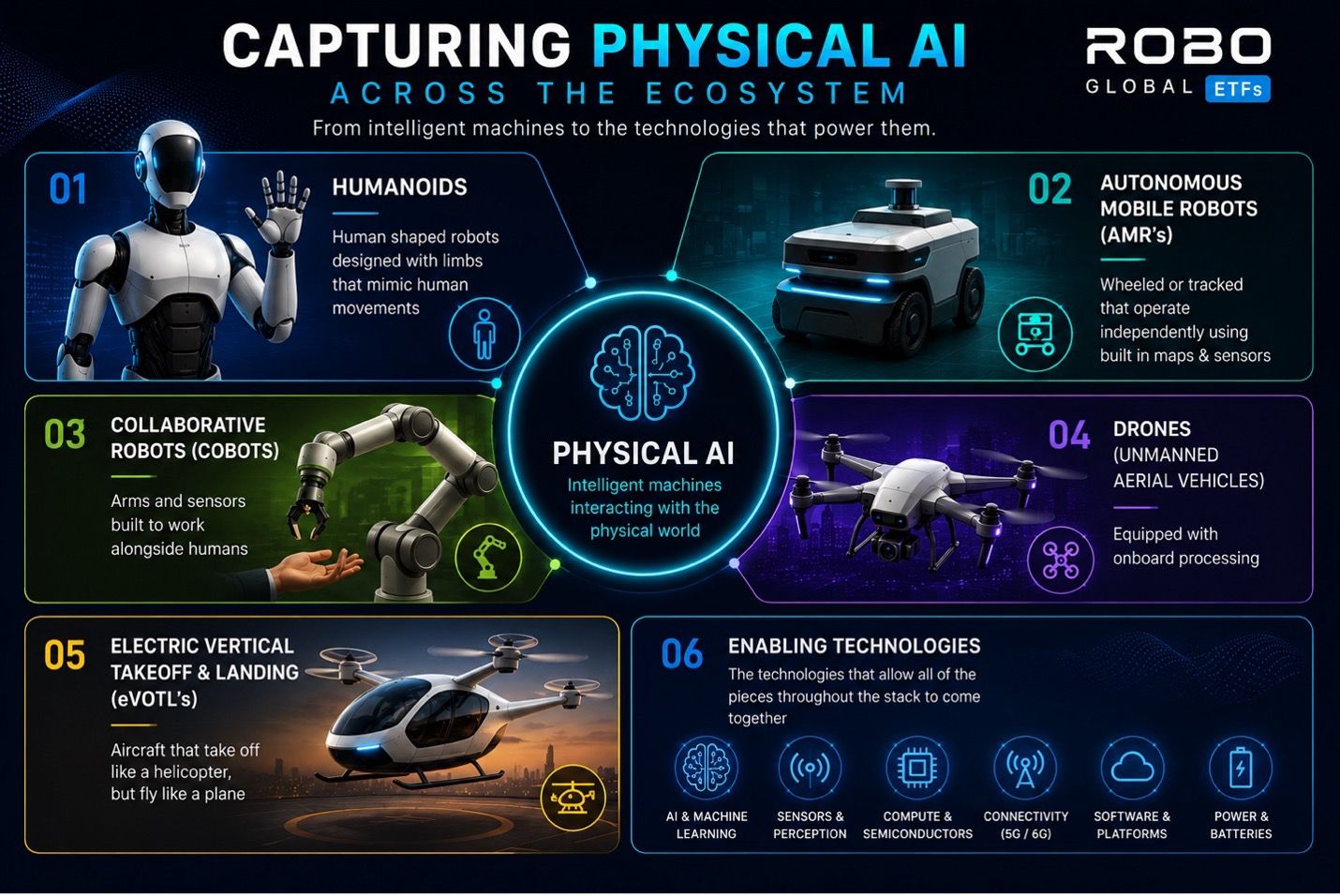
The Next Frontier of AI May Be Physical
Artificial intelligence has already transformed how information is created, analyzed, and distributed. The next phase of that evolution is increasingly taking place in the physical world. Machines are beginning to move beyond software environments and into factories, warehouses, hospitals, transportation networks, farms, infrastructure projects, and industrial facilities. Equipped with advanced sensors, machine vision, embedded computing, and increasingly sophisticated AI models, these systems can perceive their surroundings, make decisions, and perform tasks with greater autonomy than ever before.
Humanoid robots have captured much of the public's attention, but they represent only one part of a much larger opportunity. The broader theme is Physical AI: intelligent machines capable of sensing, planning, moving, and interacting with the world around them.
For investors, this distinction may matter. The long-term opportunity extends well beyond any single robot manufacturer or form factor. It encompasses the technologies, components, software platforms, and automation systems enabling an entire generation of intelligent machines. The ROBO Global Robotics & Automation Index ETF (ROBO) was built around this broader ecosystem.
|
KEY TAKEAWAYS
|
Physical AI Is Bigger Than Humanoids
Humanoid robots have emerged as one of the most visible manifestations of physical AI. Their appeal is easy to understand. Most workplaces, buildings, tools, and workflows were designed around human movement and human dimensions. A robot capable of navigating stairs, opening doors, operating tools, or working at existing stations that can potentially integrate into environments clearly has a large potential addressable market in a variety of scenarios.
Yet the future of automation is unlikely to revolve around a single robot shape. Warehouses may deploy autonomous mobile robots (AMRs), robotic picking systems, autonomous forklifts, and humanoids side-by-side. Manufacturing facilities may rely on industrial robots, collaborative robots (cobots), machine vision systems, controllers, and AI-enabled inspection tools. Construction sites, utility networks, and infrastructure projects may increasingly utilize drones and autonomous ground systems. Agriculture, where uneven terrain, weather conditions, and large open environments create unique challenges, often favors specialized robotic platforms designed specifically for planting, harvesting, crop monitoring, and precision spraying.
The common thread is not the form factor. It is the technology stack that enables machines to perceive, decide, move, and operate safely at scale. That stack is where many of the most durable investment opportunities may emerge.
Positioned Across the Physical AI Value Chain
The ROBO Global Robotics & Automation Index ETC (ROBO) was designed to capture the global robotics and automation value chain. As a result, its exposure extends beyond end-market robot manufacturers and into many of the foundational technologies enabling physical AI.
This approach reflects how robotics adoption often occurs in practice. A new robot deployment rarely consists of a single machine. It typically requires motion-control systems, sensors, machine vision, embedded computing, software platforms, simulation tools, and automation infrastructure working together. As adoption expands, demand can ripple across multiple layers of the ecosystem.
Today, ROBO's exposure spans the technologies that help machines move, see, measure, compute, and operate autonomously:
| Exposure Layer | Why It Matters | Representative ROBO Examples |
|---|---|---|
| Actuation and Motion Control | Converts software instructions into precise movement. Critical for joints, arms, grippers, mobile platforms, and flight systems. |
Harmonic Drive Systems, Nablesco, Novanta, Hirwin, THK, SMC, Delta Electronics, Microchip |
| Perception and Sensing | Allows robots to identify objects, measure distance, inspect, navigate, and operate safely around people and assets. |
Keyances, Cognex, Omron, Ambrella |
| Edge Compute and Controllers | Processes sensor data and runs autonomy, planning, and AI workloads close to the machine. |
NVIDIA, Qualcomm, AMD, Micron, Advantech |
| Software, Simulation, and Design | Supports robot design, digital twins, physics simulation, synthetice training, and reinforcement learning. |
Autodesk, NVIDIA Isaac Sim + GROOT, Rockwell Automation, Siemens |
| Robotics and Autonomuos Systems | Captures direct and adjacent exposure to emerging robot applications across multiple physical form factors, including leading humanoid developers. |
Tesla Optimus, XPENG IRON, Xiaomi CyberOne, Hexagon AEON, Estun, Joby, Ondas, Teradyne |
Holdings as of 6/22/26. Holdings subject to change. To view holdings click here.>>
Humanoids Are Moving Toward Commercial Reality
While widespread humanoid deployment remains in its early stages, recent developments suggest the industry is progressing from concept demonstrations toward pilot programs and commercial implementation.
Tesla continues to position Optimus as a general-purpose humanoid designed for repetitive, physically demanding, or hazardous tasks.1 XPENG has identified humanoid robotics as a core component of its Physical AI strategy and has publicly stated its goal of reaching large-scale humanoid production by the end of 2026.2 Industrial technology leader Hexagon has also entered the space through its AEON humanoid initiative.3
In April 2026, Hexagon and Schaeffler announced plans to deploy at least 1,000 AEON humanoids across Schaeffler's global manufacturing network over the next seven years.3 UBTECH has similarly advanced its Walker S2 platform into industrial commercialization and has publicly outlined plans for annual production capacity of 5,000 industrial humanoids in 2026 and 10,000 units by 2027.4
Private companies including Figure, Agility Robotics, Apptronik, Unitree, NEURA, and 1X continue to push the category forward as well, highlighting the growing pace of innovation across the sector. These and similar companies remain active watchlist names until they go public, get acquired or become otherwise investable and subsequently up for review by our research committee. For investors, the key takeaway may be less about identifying a single eventual winner and more about understanding the broader ecosystem supporting adoption.
Other Physical AI Form Factors Already on the Commercial Path
Although humanoids attract headlines, many other robotics categories are already operating at commercial scale.
Autonomous Mobile Robots (AMRs) and Collaborative Robots
AMRs are designed to navigate dynamic environments without fixed infrastructure, while cobots are built to work safely alongside people. These technologies are increasingly being deployed across manufacturing, logistics, warehousing, healthcare, and service industries. The rise of Robotics-as-a-Service (RaaS) models is further lowering adoption barriers by allowing businesses to access automation across construction, welding, roofing, painting, even skyscraper window cleaning, and many more “vertical” use cases without significant upfront capital investment.
Teradyne Robotics provides exposure (as of 6/22/26) to both Universal Robots' collaborative robot platforms and MiR autonomous mobile robots. In April 2026, Flex and Teradyne Robotics expanded their partnership to scale intelligent automation across global manufacturing operations, highlighting growing enterprise demand for these solutions.5 Meanwhile, larger industrial payloads, at ports, warehouses and beyond, already utilize AMR form factors at great scale.
Drones and Autonomous Ground Systems
Outside factory environments, physical AI is increasingly being deployed through autonomous aerial and ground-based systems. These platforms are used for infrastructure inspection, industrial monitoring, public safety, defense applications, surveying, and data collection. Their ability to gather information, navigate complex environments, and operate in hazardous locations continues to expand their addressable market.
Ondas Autonomous Systems provides exposure (as of 6/22/26) to AI-enabled drone platforms, autonomous ground systems, counter-UAS technologies, and advanced sensing capabilities that extend the physical AI opportunity beyond traditional industrial automation into defense, public safety, critical infrastructure, and industrial data collection.6
eVTOLs and Autonomous Mobility
Electric vertical takeoff and landing aircraft, commonly known as eVTOLs, represent another emerging category within physical AI. These systems combine electric propulsion, advanced sensing, flight controls, autonomy software, and new transportation infrastructure. While commercial deployment remains in development, progress continues.
In March 2026, Joby Aviation began flight testing its first FAA-conforming aircraft under the Type Inspection Authorization process, an important milestone on the path toward certification and commercialization. eVTOLs sit at the intersection of electric propulsion, autonomy, sensing, control systems, certification, and new mobility infrastructure.7
Investment Implications
As the physical AI ecosystem expands, a diversified value-chain framework may offer several potential advantages:
Multiple monetization pathways. Revenue can be generated across component suppliers, software platforms, automation integrators, compute providers and robot manufacturers.
Reduced dependence on a single winner. Competition is likely to emerge across humanoids, drones, autonomous vehicles, and other robotic categories. Broad exposure may help reduce single-company risk.
Exposure to technologies already seeing adoption. Industrial automation, machine vision, AMRs, cobots, drones, and related infrastructure are already generating commercial revenue today.
Optionality for future innovation. As more humanoid and autonomous systems companies become public or are acquired, the index can evaluate them against technology, market leadership, liquidity, and methodology requirements.
Looking Across The Value Chain
Physical AI is creating new ways for machines to interact with the world around them, extending artificial intelligence beyond software and into factories, warehouses, transportation networks, healthcare systems, infrastructure projects, farms, and industrial facilities. Humanoid robots may become an important part of that future, and industry forecasts are becoming increasingly meaningful. Goldman Sachs Research estimates the total addressable market for humanoid robots could reach $38 billion by 2035, with annual shipments approaching 1.4 million units as declining component costs improve the path toward commercial viability.8
For investors, the opportunity extends beyond any single robot manufacturer or technology category to the broader ecosystem of enabling technologies, software platforms, components, and autonomous systems that make physical AI possible. As adoption accelerates across industries, the companies helping machines see, move, think, and operate in the real world may collectively benefit from one of the most significant technological transitions of the coming decade.
To see all the companies powering ROBO, click here.>>
Holdings subject to change.
Sources
1. Tesla. Tesla Optimus Overview. Accessed May 12, 2026.
2. XPENG. Physical AI Emergence and Next-Generation IRON Announcement. November 5, 2025.
3. Hexagon and Schaeffler. AEON Humanoid Deployment Announcement. April 22, 2026.
4. UBTECH. Walker S2 Mass Production and Delivery Announcement. November 17, 2025.
5. Teradyne Robotics. Teradyne Robotics Overview and Flex Partnership Announcement. April 22, 2026.
6. Ondas Holdings. Ondas Autonomous Systems Business Overview. Accessed May 12, 2026.
7. Joby Aviation. First FAA-Conforming Aircraft Flight Test Announcement. March 11, 2026.
8. Goldman Sachs. “The Global Market for Humanoid Robots Could Reach $38 Billion by 2035.” February 27, 2024.

Carefully consider the Funds’ investment objectives, risk factors, charges and expenses before investing. This and additional information can be found on the Funds' full or summary prospectuses, which may be obtained at www.roboglobaletfs.com. Read the prospectus carefully before investing.
Investing involves risk, including the possible loss of principal. International investments may also involve risk from unfavorable fluctuations in currency values, differences in generally accepted accounting principles, and from economic or political instability. Emerging markets involve heightened risks related to the same factors as well as increased volatility and lower trading volume. Narrowly focused investments and investments in smaller companies typically exhibit higher volatility. There is no guarantee the funds will achieve their stated objective. ROBO and HTEC are diversified. THNQ is non-diversified.
The liquidity of the A-shares market and trading prices of A-shares could be more severely affected than the liquidity and trading prices of other markets because the Chinese government restricts the flow of capital into and out of the A-shares market. The funds may experience losses due to illiquidity of the Chinese securities markets or delay or disruption in execution or settlement of trades.
The risks associated with investments in Robotics and Automation Companies include, but are not limited to, small or limited markets for such securities, changes in business cycles, world economic growth, technological progress, rapid obsolescence, and government regulation. Robotics and Automation Companies, especially smaller, start-up companies, tend to be more volatile than securities of companies that do not rely heavily on technology. Rapid change to technologies that affect a company's products could have a material adverse effect on such company's operating results. Robotics and Automation Companies may rely on a combination of patents, copyrights, trademarks and trade secret laws to establish and protect their proprietary rights in their products and technologies. There can be no assurance that the steps taken by these companies to protect their proprietary rights will be adequate to prevent the misappropriation of their technology or that competitors will not independently develop technologies that are substantially equivalent or superior to such companies' technology.
The risks associated with Artificial Intelligence (AI) Companies include, but are not limited to, small or limited markets, changes in business cycles, world economic growth, technological progress, rapid obsolescence, and government regulation. Rapid change to technologies that affect a company’s products could have a material adverse effect on such company’s operating results. AI Companies also rely heavily on a combination of patents, copyrights, trademarks and trade secret laws to establish and protect their proprietary rights in their products and technologies. There can be no assurance that the steps taken by these companies to protect their proprietary rights will be adequate to prevent the misappropriation of their technology or that competitors will not independently develop technologies that are substantially equivalent or superior to such companies’ technology. AI Companies typically engage in significant amounts of spending on research and development, and there is no guarantee that the products or services produced by these companies will be successful.
The risks associated with Medical Technology Companies include, but are not limited to, small or limited markets for such securities, changes in business cycles, world economic growth, technological progress, rapid obsolescence, and government regulation.
Diversification may not protect against market risk.
Beginning September 2, 2020, market price returns are based on the official closing price of an ETF share or, if the official closing price isn't available, the midpoint between the national best bid and national best offer (“NBBO”) as of the time the ETF calculates current NAV per share. Prior to September 2, 2020, market price returns were based on the midpoint between the Bid and Ask price. NAVs are calculated using prices as of 4:00 PM Eastern Time. The returns shown do not represent the returns you would receive if you traded shares at other times.
The Funds are distributed by SEI Investments Distribution Co. (SIDCO) 1 Freedom Valley Drive, Oaks, PA, 19456