Investors tend to approach robotics investing by searching for the single breakout name. But automation resists that logic. It is a deep, interconnected ecosystem spanning hardware, software, sensing, and precision components, and value is distributed across every layer of that stack.
 The market opportunity is unambiguous. Industrial control and factory automation is projected to grow from approximately $275 billion in 2025 to $435 billion by 2030 a compound annual growth rate (CAGR) of roughly 9.6%.1
Multiple forces are converging to sustain that trajectory: labor-market constraints, the reshoring of manufacturing capacity, the maturation of AI-driven control systems, and the expansion of automation into sectors well beyond traditional heavy industry. In the automation economy, the infrastructure layer often captures more durable value than the application layer above it.
Against this backdrop, the ROBO Global Robotics & Automation ETF (ROBO) seeks to provide a strategic approach to investing in robotics and automation. Rather than concentrating exposure in a handful of headline names, ROBO spans approximately 80 holdings across the full automation value chain, from industrial leaders to the enabling technologies without which no robot moves, sees, or decides.2
Five Companies Powering the Stack
Understanding where value accrues in the automation ecosystem requires looking at what each company does and why its role becomes more critical as adoption scales.
LAYER 1 - MOTION & CONTROL
|
Fanuc Corporation Industrial robotics & CNC systems |
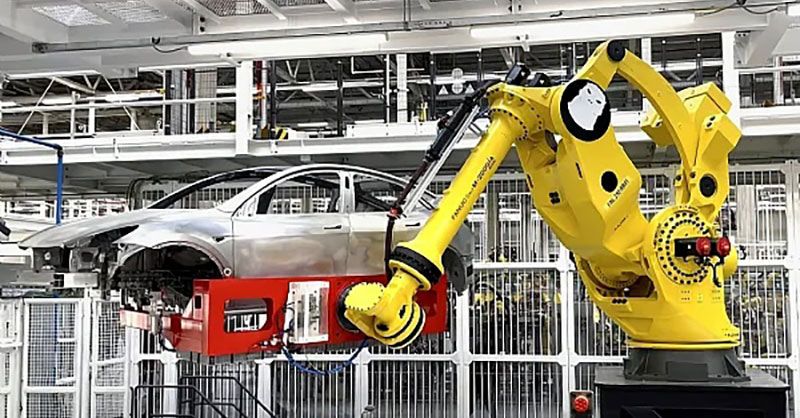
Fanuc is the world’s largest maker of industrial robots and a dominant producer In practice, Fanuc robots weld vehicle frames on automotive assembly lines, |
|
Rockwell Automation Industrial software & control systems |
Rockwell is the largest pure-play industrial automation company globally, A food and beverage producer, for instance, might use Rockwell’s PLCs to |
LAYER 2 - VISION & SENSING
|
Cognex Corporation Machine vision systems |
Cognex builds the “eyes” of automated systems - camera-based vision On an EV battery assembly line, Cognex vision systems scan electrode films for |
|
Keyence Corporation Precision sensors & measurement |
Keyence is the instrumentation layer of the automation stack. The Japan In automotive manufacturing, Keyence laser profilers measure door gap and |
LAYER 3 - ENABLING COMPONENTS
|
IPG Photonics High-power fiber lasers |
IPG Photonics invented the high-power fiber laser in 1990 and remains the world’s The practical applications span nearly every industrial sector: IPG’s lasers weld |
The Compounding Logic of the Stack
What makes this ecosystem compelling as an investment framework is that the layers reinforce each other. Every new Fanuc robot deployed requires a Cognex vision system to guide it, Keyence sensors to verify its output, Rockwell software to integrate it into the production workflow, and IPG lasers to cut or weld the materials it handles. Demand at the system level generates cascading demand across the stack.
Each of these layers is generative rather than merely supportive. As robot deployments scale globally, the demand for sensors, vision systems, and precision components scales proportionally. These are recurring, embedded relationships woven into the production architectures of the world’s largest manufacturers and that recurring nature matters.
The strategic insight for investors is structural: single-company concentration in robotics may expose you to product cycles, competitive displacement, and geographic concentration risk. The ROBO approach is designed to capture the broad expansion of the sector while no single holding dominates the outcome. The top position currently represents just over 2% of the fund.3
The investment thesis centers on owning the infrastructure layer of a structural, decade-long transformation. Sensors go into every robot. Vision systems validate every production run. Photonics cut and weld every assembly.
Automation is a layer of the global economy being rebuilt from the ground up. ROBO is structured to own that rebuild across every layer.
SOURCES:
1. MarketsandMarkets. “Industrial Control & Factory Automation Market Worth $435.24 Billion by 2030.” PR Newswire, January 12, 2026.
2. Motley Fool. “How to Buy Robo Global Robotics & Automation Index ETF (ROBO).” Accessed April 2026.
3. Stock Analysis. “ROBO Holdings List – ROBO Global Robotics & Automation Index ETF.” Accessed April 2026.
4. FANUC Corporation. “Total Shipment of 1 Million Units of FANUC Robot.” News Release, September 15, 2023.
5. PitchBook / Morningstar. “Rockwell Automation 2025 Company Profile.” Accessed April 2026.
6. Cognex Corporation. “Machine Vision.” Product page, accessed April 2026.
7. Cognex Corporation. Form 8-K, Q3 2023. U.S. Securities and Exchange Commission. https://www.sec.gov/Archives/edgar/data/0000851205/000115752323000715/a53392890ex99_1.htm
8. Wikipedia. “Keyence.” Accessed April 2026. https://en.wikipedia.org/wiki/Keyence
9. Keyence Corporation. “Measurement Sensors for the Semiconductor Industry.”
10. IPG Photonics Corporation. “About IPG Innovation.”
11. IPG Photonics Corporation. Form DEF 14A, FY2024. U.S. Securities and Exchange Commission.
For current holdings click HERE. Holdings subject to change.

Carefully consider the Funds’ investment objectives, risk factors, charges and expenses before investing. This and additional information can be found on the Funds' full or summary prospectuses, which may be obtained at www.roboglobaletfs.com. Read the prospectus carefully before investing.
Investing involves risk, including the possible loss of principal. International investments may also involve risk from unfavorable fluctuations in currency values, differences in generally accepted accounting principles, and from economic or political instability. Emerging markets involve heightened risks related to the same factors as well as increased volatility and lower trading volume. Narrowly focused investments and investments in smaller companies typically exhibit higher volatility. There is no guarantee the funds will achieve their stated objective. ROBO and HTEC are diversified. THNQ is non-diversified.
The liquidity of the A-shares market and trading prices of A-shares could be more severely affected than the liquidity and trading prices of other markets because the Chinese government restricts the flow of capital into and out of the A-shares market. The funds may experience losses due to illiquidity of the Chinese securities markets or delay or disruption in execution or settlement of trades.
The risks associated with investments in Robotics and Automation Companies include, but are not limited to, small or limited markets for such securities, changes in business cycles, world economic growth, technological progress, rapid obsolescence, and government regulation. Robotics and Automation Companies, especially smaller, start-up companies, tend to be more volatile than securities of companies that do not rely heavily on technology. Rapid change to technologies that affect a company's products could have a material adverse effect on such company's operating results. Robotics and Automation Companies may rely on a combination of patents, copyrights, trademarks and trade secret laws to establish and protect their proprietary rights in their products and technologies. There can be no assurance that the steps taken by these companies to protect their proprietary rights will be adequate to prevent the misappropriation of their technology or that competitors will not independently develop technologies that are substantially equivalent or superior to such companies' technology.
The risks associated with Artificial Intelligence (AI) Companies include, but are not limited to, small or limited markets, changes in business cycles, world economic growth, technological progress, rapid obsolescence, and government regulation. Rapid change to technologies that affect a company’s products could have a material adverse effect on such company’s operating results. AI Companies also rely heavily on a combination of patents, copyrights, trademarks and trade secret laws to establish and protect their proprietary rights in their products and technologies. There can be no assurance that the steps taken by these companies to protect their proprietary rights will be adequate to prevent the misappropriation of their technology or that competitors will not independently develop technologies that are substantially equivalent or superior to such companies’ technology. AI Companies typically engage in significant amounts of spending on research and development, and there is no guarantee that the products or services produced by these companies will be successful.
The risks associated with Medical Technology Companies include, but are not limited to, small or limited markets for such securities, changes in business cycles, world economic growth, technological progress, rapid obsolescence, and government regulation.
Diversification may not protect against market risk.
Beginning September 2, 2020, market price returns are based on the official closing price of an ETF share or, if the official closing price isn't available, the midpoint between the national best bid and national best offer (“NBBO”) as of the time the ETF calculates current NAV per share. Prior to September 2, 2020, market price returns were based on the midpoint between the Bid and Ask price. NAVs are calculated using prices as of 4:00 PM Eastern Time. The returns shown do not represent the returns you would receive if you traded shares at other times.
The Funds are distributed by SEI Investments Distribution Co. (SIDCO) 1 Freedom Valley Drive, Oaks, PA, 19456