ROBO Global Robotics & Automation Index
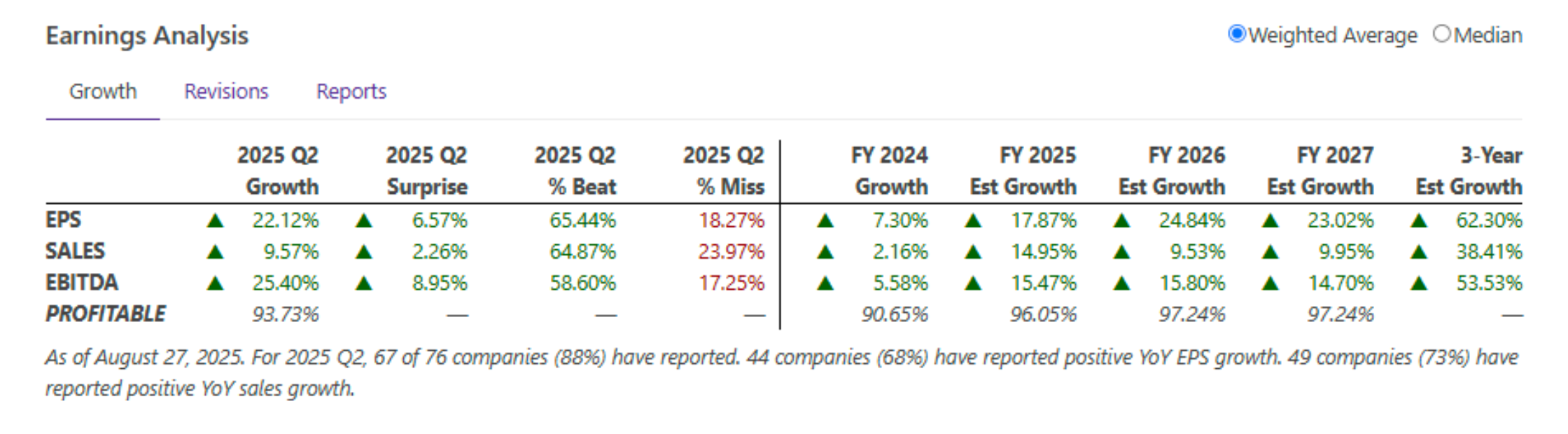
The “Earnings Analysis” chart, based on data from VettaFi research and FactSet Data, provides insights into past earnings performance and future expectations, including EPS growth, sales, EBITDA, and profitability trends for various sectors for the holdings of ROBO.
EBITDA (Earnings Before Interest, Taxes, Depreciation, and Amortization) - A measure of a company's operating performance that shows how much cash a business generates before accounting for financing costs and accounting adjustments.
You can see the recovery starting → and we believe wall street is underappreciating the growth cycle ahead.
ROBO Global Robotics & Automation Index ETF (ROBO)
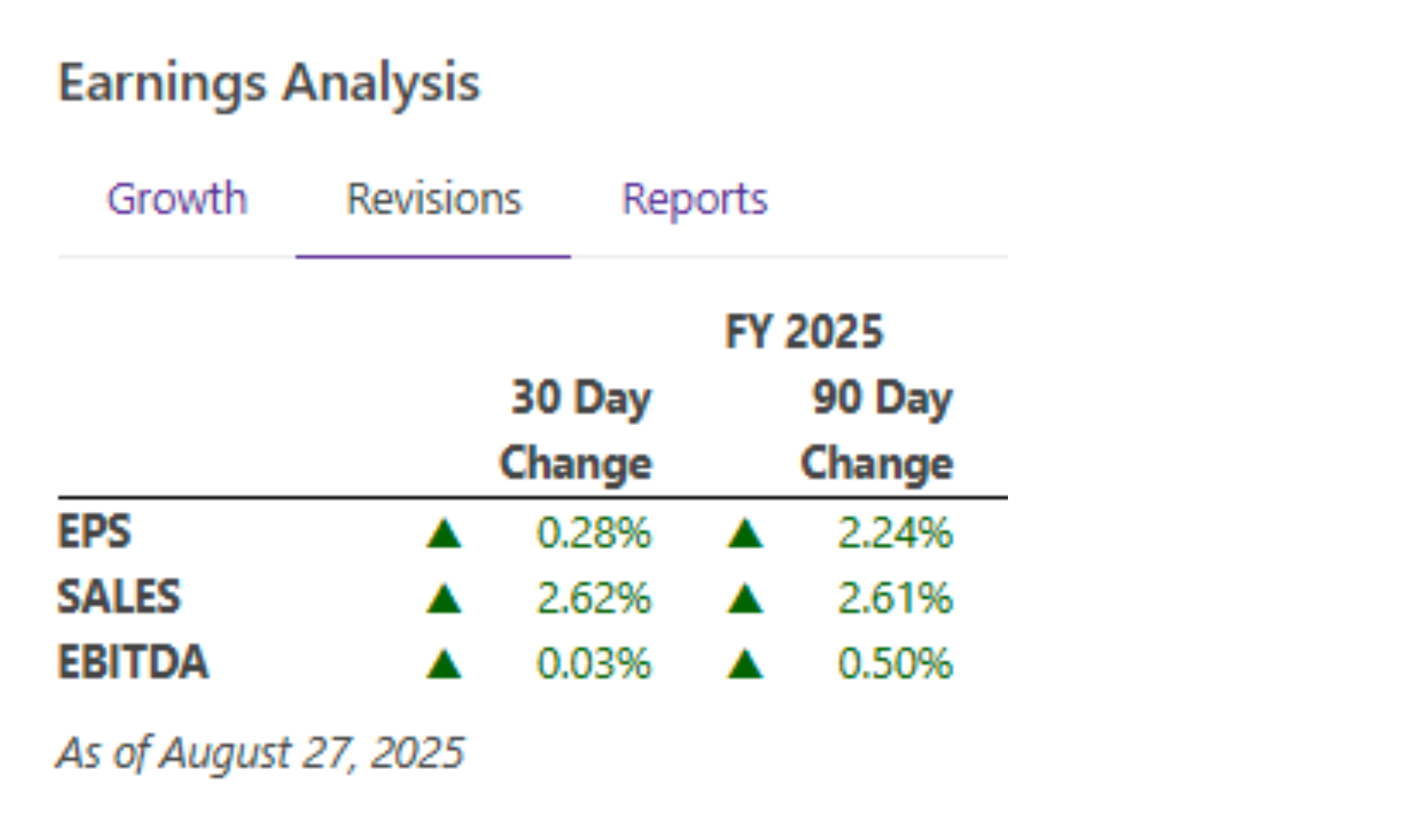
The “Earnings Analysis” chart, based on data from VettaFi research and FactSet Data, provides insights into past earnings performance and future expectations, including EPS growth, sales, EBITDA, and profitability trends for various sectors for the holdings of ROBO.
 ROBO index constituents boast a 94% profitability rate and solid growth metrics, pointing to the resilience of companies in robotics and automation.
As Q2 2025 earnings season wraps, the ROBO Global universe has shown notable resilience despite tariff headlines and geopolitical noise. The results reinforce the view that automation and robotics are durable, long-term growth trends.
The Profitability Story
The numbers below reflect ROBO Global's internal index screens across our investable universe through August 24, 2025:
- 94% of companies profitable
- 83% of constituents reported Q2 results so far
- Weighted average sales growth: 9%, weighted average Earnings per Share (EPS) growth: 22%
- Average beats: roughly +2% on sales, +6% on EPS
We expect profitability to trend toward approximately 96% by year-end, based on current run-rate and guidance. [1]
Tariffs: Headwind or Tailwind?
Robotics suppliers continue to lean into supply chain diversification and onshoring or nearshoring, which is offsetting many tariff concerns.
Key examples of reshoring and limited tariff impact include:
Cognex cited logistics strength and factory-automation demand, with management noting no material impact from tariffs in its Q2 materials. [2]
Analog Devices raised near-term guidance on broad industrial strength, while acknowledging policy uncertainty, which underscores demand resilience in core end markets. [3]
Aptiv guided above Street on full-year EPS despite auto-tariff noise, and outlined Q3 that is flat to slightly softer on revenue, which is consistent with a mixed but manageable demand picture. [4]
Standout Performers and Emerging Themes
XPeng: A Diversified Automation Bet
Recent results show record deliveries and a significant loss reduction with gross margin at 17.3%, illustrating operating leverage from software and manufacturing scale. XPeng is also investing in embodied AI, including a humanoid robot program and a separate flying-car unit, AeroHT, which recently secured $250 million Series B financing to accelerate commercialization. [5]
Infrastructure Still Leads, Applications Accelerate Next
The THNQ's index's framework remains about 65% infrastructure and 35% applications, a mix aligned with where most AI monetization occurs today. Independent write-ups and index commentary continue to reflect this split. [6]
Example of emerging monetization: Cloudflare introduced controls to block or charge AI crawlers and manage content access for training, a direct response to AI-driven demand on the web. [7]
The Interface Shift to On-Body Computing
Meta's AR efforts pair glasses plus a wrist wearable using sEMG (surface Electromyography) for fine-grained control. Meta has publicly documented the Orion AR program and recent sEMG wristband research, and multiple reports indicate a forthcoming consumer glasses and wrist band combination. This direction could open new subscription and services revenue paths, although Meta has not provided specific ARPU (Average Revenue Per User) targets. [8]
Supply chain note: The THNQ index's constituents include TSMC and MediaTek, both exposed to wearable and edge-AI demand. [9]
Sector Resilience in Action
Diversified end-markets continue to buffer macro swings:
Healthcare robotics: Hospital runners such as Moxi are scaling for deliveries of meds, labs, and supplies, freeing nurses for patient care. [10]
Manufacturing automation: Robot density and installations continue to rise, with IFR (International Federation of Robotics) reporting record operational stock and higher density, which supports 24/7 operations. [11]
Agricultural automation: John Deere highlighted next-gen autonomy at CES (Consumer Electronics Show) 2025, and targeted spraying systems such as See & Spray show tangible ROI for farmers. [12]
Logistics automation: Retailers and e-commerce players continue investing in automated warehouses and AMRs (Autonomous Mobile Robots) to improve throughput and cost per order. [13]
Looking Forward: Key Themes
The inference economy: More AI will run on devices, robots, and vehicles, connected to cloud services via an "inference bridge." This favors companies straddling hardware plus network or data layers. [14]
Multiple form factors: Humanoids are advancing fast, yet task-specific machines often win on unit economics, for example, farm equipment, cobots, and warehouse AMRs. [15] [16]
Potential Investment Implications
Quality over hype. Profitability and cash generation are differentiators in 2025. [17]
Diversification matters. Exposure across healthcare, industrials, automotive, logistics, and ag smooths cycles.
Reshoring as a support. Onshoring or nearshoring continues to create opportunities for automation suppliers, while several companies report limited direct tariff drag. [18]
Infrastructure first: The foundation for the next wave of applications is still being built, consistent with the 65% or 35% monetization mix noted above. [19]
Bottom Line
Volatility aside, adoption drivers remain intact. Companies are investing in efficiency, supply chains are diversifying, and embodied AI performance is improving. The 94% profitability we see across our coverage reflects a mature sector delivering cash flow from real deployments, not just future promises. (Internal ROBO analysis.)
Sources:
[1] ROBO Global. Internal index screen across investable universe. Data cut-off: August 24, 2025.
[2] Cognex Corporation. Cognex Reports Second Quarter 2025 Results. Press release, July 30, 2025. investor.cognex.com
[3] Reuters. Analog Devices forecasts upbeat results on strong industrial demand. Published August 20, 2025.
[4] Reuters. Aptiv forecasts better-than-expected 2025 profit despite auto tariffs hit. Published July 31, 2025.
[5] GlobeNewswire. XPeng AeroHT Completes $250 Million Series B Financing. Published July 15, 2025. Also covered by Wall Street Journal, Barron’s, Electrek, and eVTOL Insights in mid-July 2025.
[6] Kiplinger. AI ETFs: The Infrastructure vs. Applications Split. Published July 2025. See also ETF Stream coverage, August 2025.
[7] Cloudflare. Introducing Content Independence Day: Blocking AI Crawlers and Launching Pay-Per-Crawl. Company blog post, July 1, 2025.
[8] Meta (About Facebook). Introducing Orion: AR glasses and neural input research. First published September 2024, with continued coverage in Tom’s Guide and The Times of India through 2025.
[9] VettaFi. THNQ Index Holdings and Fact Sheet. Updated August 2025.
[10] The Robot Report. Moxi the hospital robot surpasses 300,000 deliveries. Published July 2025. See also Diligent Robotics company blog, July 2025.
[11] International Federation of Robotics (IFR). World Robotics 2024 Report. Published September 2024. IFR announced World Robotics 2025 scheduled for September 25, 2025.
[12] John Deere. John Deere Reveals New Autonomous Machines and Technology at CES 2025. Press release, January 6, 2025. See also Successful Farming CES 2025 coverage, January 7, 2025.
[13] Reuters. Retailers, e-commerce invest in automated warehouses to boost throughput. Multiple articles across 2024–2025. See also Global Market Insights Inc., Warehouse Automation Market Report 2025. Published June 2025.
[14] ROBO Global (Thematic View). The Inference Economy. Thematic commentary, 2025.
[15] International Federation of Robotics. World Robotics 2024 Report. Published September 2024; vendor disclosures ongoing in 2024–2025.
[16] International Federation of Robotics. World Robotics 2024 Report. Published September 2024.
[17] ROBO Global. Internal profitability screens. Analysis dated 2025.
[18] Q4 Capital and Reuters. Reshoring trends and limited tariff drag in industrial automation. Coverage spanning July–August 2025.
[19] Kiplinger. AI ETFs and Infrastructure Themes. Published July 2025.
LLM (Large Language Model) - Advanced AI systems like ChatGPT that can understand and generate human-like text by processing massive amounts of data.
sEMG (surface Electromyography) - Technology that measures electrical activity in muscles through sensors placed on the skin, commonly used in medical diagnostics and robotics.
ARPU (Average Revenue Per User) - A key business metric that calculates how much money a company generates on average from each customer over a specific time period.
IFR (International Federation of Robotics) - The global industry association that tracks robotics statistics and trends worldwide, serving as the authoritative source for robot deployment data.
CES (Consumer Electronics Show) - The world's largest annual technology trade show held in Las Vegas where companies unveil their latest innovations and products.
AMRs (Autonomous Mobile Robots) - Self-navigating robots that can move around warehouses, factories, or other environments without human control to perform tasks like delivery or inventory management.
Diversification may not protect against market risk.
This article represents an assessment of the market environment at a specific time and is not intended to be a forecast of future events or a guarantee of future results. This information should not be relied upon by the reader as research or investment advice regarding any security in particular. This research is provided for educational purposes only.

Carefully consider the Funds’ investment objectives, risk factors, charges and expenses before investing. This and additional information can be found on the Funds' full or summary prospectuses, which may be obtained at www.roboglobaletfs.com. Read the prospectus carefully before investing.
Investing involves risk, including the possible loss of principal. International investments may also involve risk from unfavorable fluctuations in currency values, differences in generally accepted accounting principles, and from economic or political instability. Emerging markets involve heightened risks related to the same factors as well as increased volatility and lower trading volume. Narrowly focused investments and investments in smaller companies typically exhibit higher volatility. There is no guarantee the funds will achieve their stated objective. ROBO and HTEC are diversified. THNQ is non-diversified.
The liquidity of the A-shares market and trading prices of A-shares could be more severely affected than the liquidity and trading prices of other markets because the Chinese government restricts the flow of capital into and out of the A-shares market. The funds may experience losses due to illiquidity of the Chinese securities markets or delay or disruption in execution or settlement of trades.
The risks associated with investments in Robotics and Automation Companies include, but are not limited to, small or limited markets for such securities, changes in business cycles, world economic growth, technological progress, rapid obsolescence, and government regulation. Robotics and Automation Companies, especially smaller, start-up companies, tend to be more volatile than securities of companies that do not rely heavily on technology. Rapid change to technologies that affect a company's products could have a material adverse effect on such company's operating results. Robotics and Automation Companies may rely on a combination of patents, copyrights, trademarks and trade secret laws to establish and protect their proprietary rights in their products and technologies. There can be no assurance that the steps taken by these companies to protect their proprietary rights will be adequate to prevent the misappropriation of their technology or that competitors will not independently develop technologies that are substantially equivalent or superior to such companies' technology.
The risks associated with Artificial Intelligence (AI) Companies include, but are not limited to, small or limited markets, changes in business cycles, world economic growth, technological progress, rapid obsolescence, and government regulation. Rapid change to technologies that affect a company’s products could have a material adverse effect on such company’s operating results. AI Companies also rely heavily on a combination of patents, copyrights, trademarks and trade secret laws to establish and protect their proprietary rights in their products and technologies. There can be no assurance that the steps taken by these companies to protect their proprietary rights will be adequate to prevent the misappropriation of their technology or that competitors will not independently develop technologies that are substantially equivalent or superior to such companies’ technology. AI Companies typically engage in significant amounts of spending on research and development, and there is no guarantee that the products or services produced by these companies will be successful.
The risks associated with Medical Technology Companies include, but are not limited to, small or limited markets for such securities, changes in business cycles, world economic growth, technological progress, rapid obsolescence, and government regulation.
Diversification may not protect against market risk.
Beginning September 2, 2020, market price returns are based on the official closing price of an ETF share or, if the official closing price isn't available, the midpoint between the national best bid and national best offer (“NBBO”) as of the time the ETF calculates current NAV per share. Prior to September 2, 2020, market price returns were based on the midpoint between the Bid and Ask price. NAVs are calculated using prices as of 4:00 PM Eastern Time. The returns shown do not represent the returns you would receive if you traded shares at other times.
The Funds are distributed by SEI Investments Distribution Co. (SIDCO) 1 Freedom Valley Drive, Oaks, PA, 19456