
Agentic Commerce at a Glance
Up to $1 trillion in U.S. retail sales could be influenced by AI-powered shopping agents by 2030, with $3–5 trillion globally.1
4,700% year-over-year increase in traffic from generative AI sources to U.S. retail websites in July 2025.2
The global warehouse automation market is projected to grow from approximately $27.4 billion in 2026 to nearly $59.5 billion by 2030 as retailers automate fulfillment to meet growing demand.3
You've probably already started using agentic commerce without realizing it. Maybe you've asked an AI assistant like Alexa to reorder coffee, compare prices on a new laptop, recommend a birthday gift, or automatically replenish household essentials. Instead of simply answering questions, the newest generation of AI is beginning to complete entire shopping tasks on your behalf.
This shift is known as agentic commerce, a new paradigm in digital commerce in which autonomous AI agents can independently complete the entire shopping journey on a consumer's behalf from product discovery to purchase and ongoing replenishment. Unlike traditional search engines that simply return information, these agents can evaluate alternatives, weigh reviews, apply your preferences, and increasingly manage the entire purchasing process, with consumers providing only the final sign-off before the transaction is completed.
For consumers, shopping becomes faster and more personalized. For businesses, it has the potential to reshape how demand is created and that opportunity may be significant. McKinsey estimates AI-powered shopping agents could influence as much as $1 trillion in U.S. retail revenue and $3-$5 trillion globally by 2030.1 Adobe Analytics is already seeing early evidence of that shift, reporting that traffic from generative AI platforms to U.S. retail websites increased 4,700% year over year.2
Much of the conversation around agentic commerce focuses on how AI is transforming the buying decision. However, the equally important question is what happens after the purchase is made. An AI agent can decide what to buy in seconds. It cannot manufacture the product, retrieve it from inventory, inspect it for quality, package it, move it through a fulfillment center, or load it onto a delivery truck. Every online purchase still travels through factories, warehouses and logistics networks before it reaches a customer's doorstep.
As AI makes purchasing easier and more frequent, the physical systems supporting commerce must become faster, more efficient and increasingly automated. That is where robotics enters the story.
Every dollar that flows through a software agent eventually flows through a robot.
Warehouses processing thousands of AI-generated orders require autonomous storage systems. Distribution centers need robotic picking, sorting and material handling. Manufacturers rely on industrial robots to increase throughput while maintaining precision. Machine vision systems inspect products at speeds impossible for human workers, while industrial automation software coordinates these increasingly complex operations. The rising demand from agentic commerce increases the importance of the physical economy.
Several holdings (as of 7/23/26) in the ROBO Global Robotics & Automation Index ETF (ROBO) help provide the infrastructure that turns AI-generated decisions into physical outcomes and automate the movement of goods throughout the global economy.
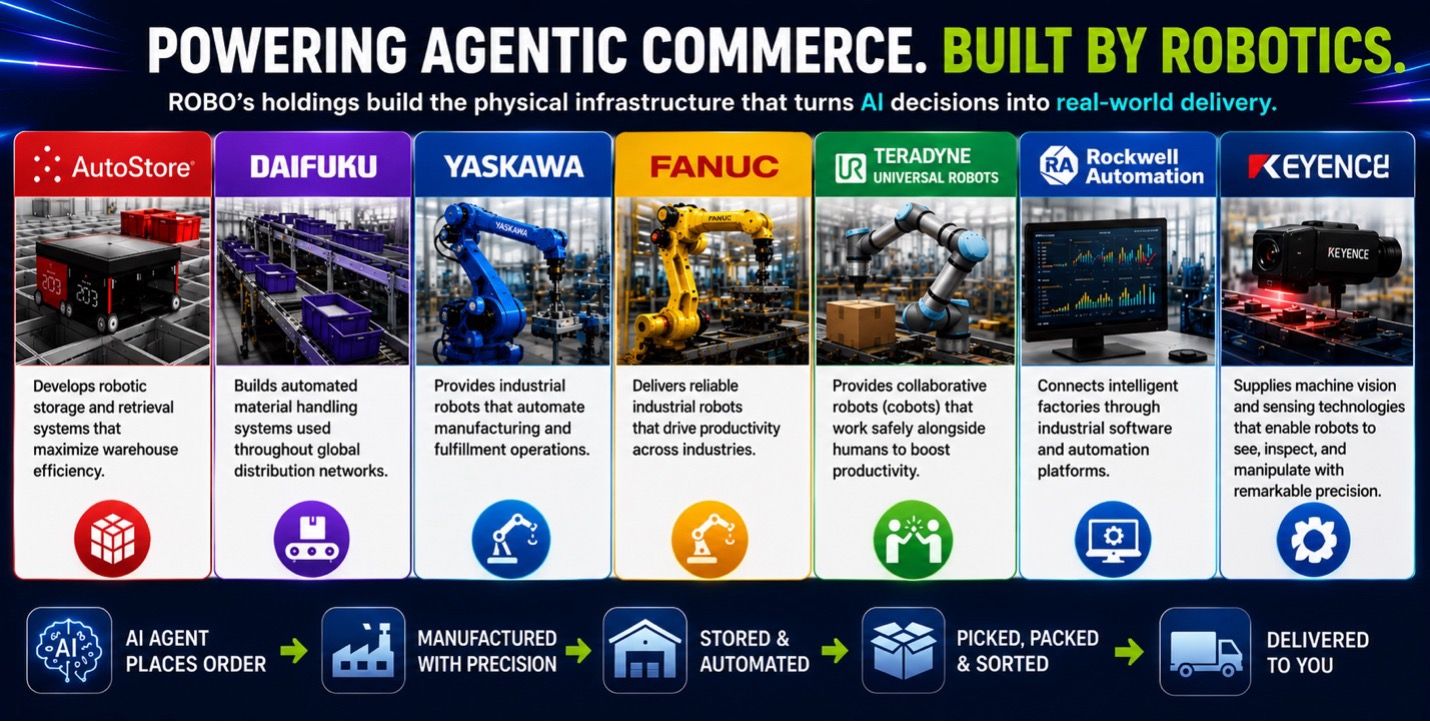
The need for that infrastructure is only growing. The global warehouse robotics market is projected to more than double over the next five years as retailers expand product selection, labor markets remain tight and consumers increasingly expect next-day or even same-day delivery.4
Agentic commerce has the potential to accelerate each of these trends by increasing transaction volumes while compressing the time between purchase decisions and fulfillment. Every improvement in AI's ability to generate demand, places greater importance on the robotics and automation systems responsible for fulfilling it.
For investors, that may broaden the AI opportunity set beyond semiconductors, hyperscalers, and large language models. It highlights the companies building the intelligent factories, automated warehouses, robotic logistics systems, and industrial control technologies that allow autonomous commerce to function at scale.
The next phase of AI may not be defined solely by who builds the smartest software agents, but by who enables those agents to operate in the physical world. As machine-generated commerce accelerates, the companies powering that physical layer could become some of the most important beneficiaries of the AI economy. After all, every digital transaction eventually becomes a physical one and increasingly, that physical work is performed by intelligent machines.
Explore the companies in ROBO that are helping build the intelligent infrastructure powering the next generation of commerce.
View ROBO Holdings Here →. Holdings subject to change.
Sources:
1. McKinsey & Company and ICSC. "The Agentic Commerce Opportunity: How AI Agents Are Ushering in a New Era for Consumers and Merchants." McKinsey & Company, October 2025.
2. Adobe Analytics, Generative AI Shopping Trends Report, 2025.
3. Grand View Research. Warehouse Automation Market Size, Share & Trends Analysis Report, 2024–2030.
4. Mordor Intelligence, Warehouse Robotics Market – Growth, Trends, Forecasts (2026–2031).
What is agentic commerce?
Agentic commerce is a form of AI-enabled shopping where software agents search, compare, recommend, and complete purchases on behalf of consumers or businesses.
Why does agentic commerce matter for robotics?
Every AI-driven order still has to be manufactured, stored, picked, packed, sorted, and delivered. That creates demand for robotics, automation, machine vision, and warehouse technology.
How does ROBO ETF relate to agentic commerce?
ROBO seeks exposure to companies involved in robotics, automation, machine vision, material handling, and intelligent systems that help support the physical infrastructure behind AI-driven commerce.

Carefully consider the Funds’ investment objectives, risk factors, charges and expenses before investing. This and additional information can be found on the Funds' full or summary prospectuses, which may be obtained at www.roboglobaletfs.com. Read the prospectus carefully before investing.
Investing involves risk, including the possible loss of principal. International investments may also involve risk from unfavorable fluctuations in currency values, differences in generally accepted accounting principles, and from economic or political instability. Emerging markets involve heightened risks related to the same factors as well as increased volatility and lower trading volume. Narrowly focused investments and investments in smaller companies typically exhibit higher volatility. There is no guarantee the funds will achieve their stated objective. ROBO and HTEC are diversified. THNQ is non-diversified.
The liquidity of the A-shares market and trading prices of A-shares could be more severely affected than the liquidity and trading prices of other markets because the Chinese government restricts the flow of capital into and out of the A-shares market. The funds may experience losses due to illiquidity of the Chinese securities markets or delay or disruption in execution or settlement of trades.
The risks associated with investments in Robotics and Automation Companies include, but are not limited to, small or limited markets for such securities, changes in business cycles, world economic growth, technological progress, rapid obsolescence, and government regulation. Robotics and Automation Companies, especially smaller, start-up companies, tend to be more volatile than securities of companies that do not rely heavily on technology. Rapid change to technologies that affect a company's products could have a material adverse effect on such company's operating results. Robotics and Automation Companies may rely on a combination of patents, copyrights, trademarks and trade secret laws to establish and protect their proprietary rights in their products and technologies. There can be no assurance that the steps taken by these companies to protect their proprietary rights will be adequate to prevent the misappropriation of their technology or that competitors will not independently develop technologies that are substantially equivalent or superior to such companies' technology.
The risks associated with Artificial Intelligence (AI) Companies include, but are not limited to, small or limited markets, changes in business cycles, world economic growth, technological progress, rapid obsolescence, and government regulation. Rapid change to technologies that affect a company’s products could have a material adverse effect on such company’s operating results. AI Companies also rely heavily on a combination of patents, copyrights, trademarks and trade secret laws to establish and protect their proprietary rights in their products and technologies. There can be no assurance that the steps taken by these companies to protect their proprietary rights will be adequate to prevent the misappropriation of their technology or that competitors will not independently develop technologies that are substantially equivalent or superior to such companies’ technology. AI Companies typically engage in significant amounts of spending on research and development, and there is no guarantee that the products or services produced by these companies will be successful.
The risks associated with Medical Technology Companies include, but are not limited to, small or limited markets for such securities, changes in business cycles, world economic growth, technological progress, rapid obsolescence, and government regulation.
Diversification may not protect against market risk.
Beginning September 2, 2020, market price returns are based on the official closing price of an ETF share or, if the official closing price isn't available, the midpoint between the national best bid and national best offer (“NBBO”) as of the time the ETF calculates current NAV per share. Prior to September 2, 2020, market price returns were based on the midpoint between the Bid and Ask price. NAVs are calculated using prices as of 4:00 PM Eastern Time. The returns shown do not represent the returns you would receive if you traded shares at other times.
The Funds are distributed by SEI Investments Distribution Co. (SIDCO) 1 Freedom Valley Drive, Oaks, PA, 19456